GainingSunCurrent Affairs and GK

Daily UPSC Current Affairs

India-Australia Defence Dialogue 2026: Maritime Awareness, MLSA & Indo-Pacific Cooperation Explained
India and Australia held the 2nd India-Australia Defence Ministers' Dialogue in New Delhi on 1 June 2026, advancing maritime domain awareness, defence co-production and Indo-Pacific security cooperation. This explainer covers the dialogue's key outcomes, the Comprehensive Strategic Partnership, the Mutual Logistics Support Arrangement, the Quad and IPMDA, major bilateral exercises and the full UPSC relevance for Prelims and Mains. UPSC Syllabus Mapping GS Paper 2 (International Relations): Bilateral, regional and global groupings and agreements involving India and/or affecting India's interests; India and its strategic partners; effect of policies and politics of developed and developing countries on India's interests. GS Paper 3 (Security): Security challenges and their management in border areas; role of external state actors; various security forces and agencies and their mandate; maritime security. Prelims: Defence exercises, institutional mechanisms (2+2, Defence Ministers' Dialogue), Quad, IORA, IPOI, IPMDA, IFC-IOR, UNCLOS, ECTA/CECA.
• India's Defence Minister Rajnath Singh and Australian Deputy PM and Defence Minister Richard Marles co-chaired the 2nd India-Australia Defence Ministers' Dialogue in New Delhi on 1 June 2026.
• It reviewed progress since the inaugural Dialogue held in Australia on 9 October 2025.
+30 more points...
Q1. What exactly is the news event, and who participated The event: On 1 June 2026, India's Defence Minister Rajnath Singh and Australia's Deputy Prime Minister and Minister for De...
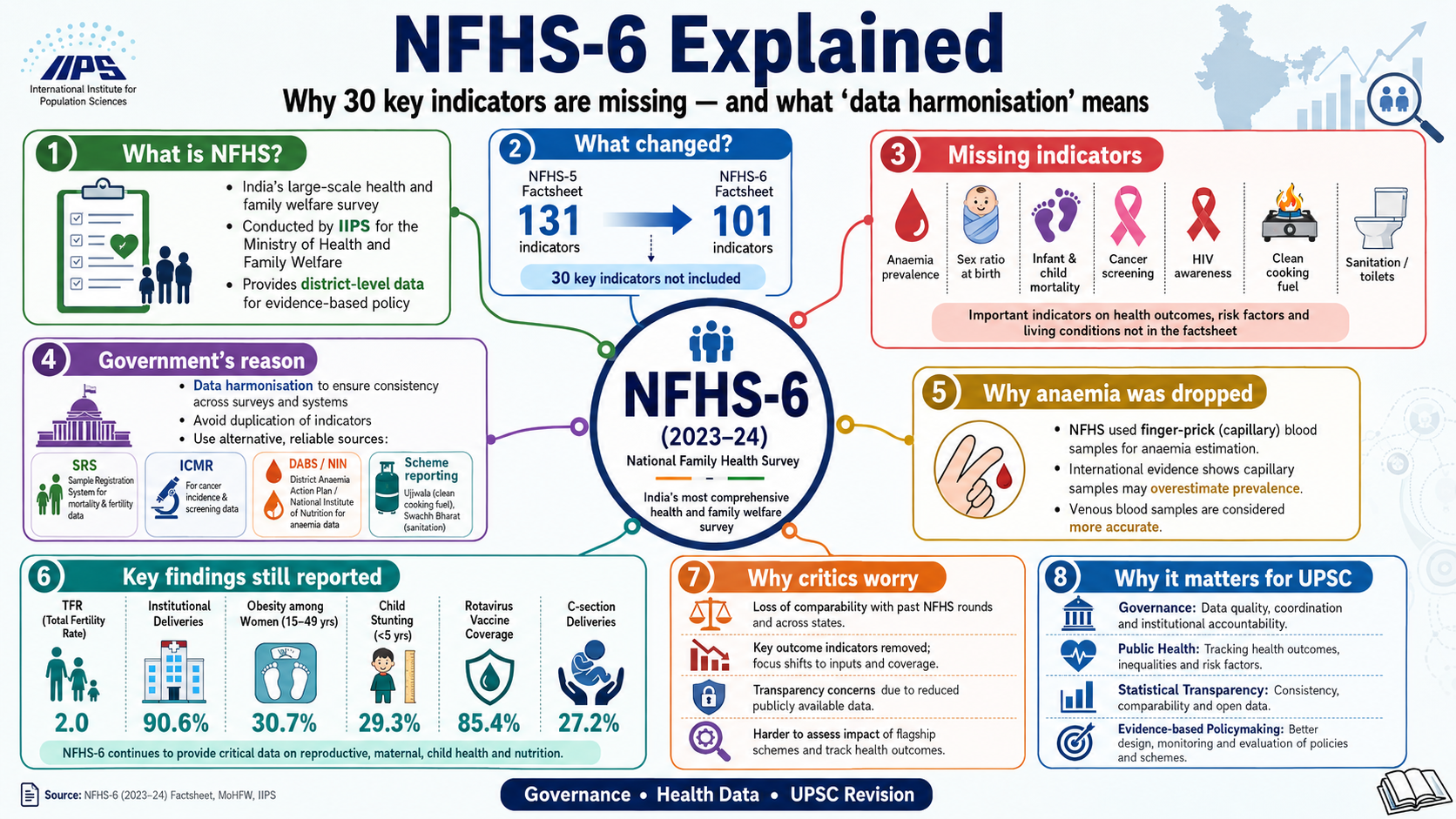
NFHS-6 Explained: Why 30 Key Indicators on Anaemia, Sex Ratio & Cancer Screening Are Missing, and What "Data Harmonisation" Means
The Ministry of Health and Family Welfare released the National Family Health Survey-6 (NFHS-6, 2023-24) factsheets on 29 May 2026, and the number of indicators has fallen from 131 in NFHS-5 to 101 — with data on anaemia prevalence, sex ratio at birth, infant and child mortality, cancer screening, HIV awareness, clean cooking fuel and sanitation no longer reported. The government calls it "data harmonisation"; critics call it suppression. This article explains what NFHS is, why these indicators were dropped, the meaning of data harmonisation, the role of the Sample Registration System and ICMR, and the survey's key health findings on fertility, obesity and immunisation for the UPSC GS-II Governance and Health syllabus.
• The Ministry of Health and Family Welfare (MoHFW) released the NFHS-6 (2023-24) national and State/UT factsheets on 29 May 2026.
• The number of key indicators in the factsheet has dropped from 131 in NFHS-5 (2019-21) to 101 in NFHS-6 — a net reduction, with reports indicating roughly 43 indicators removed and around 13 new ones added.
+9 more points...
Q1. What is the National Family Health Survey (NFHS), and who conducts it Definition and nature: The National Family Health Survey is a large-scale, multi-round household survey co...
"The reduction of key indicators in the NFHS-6 factsheet has reignited the debate between data harmonisation and statistical transparency in India." In this context, examine the im...
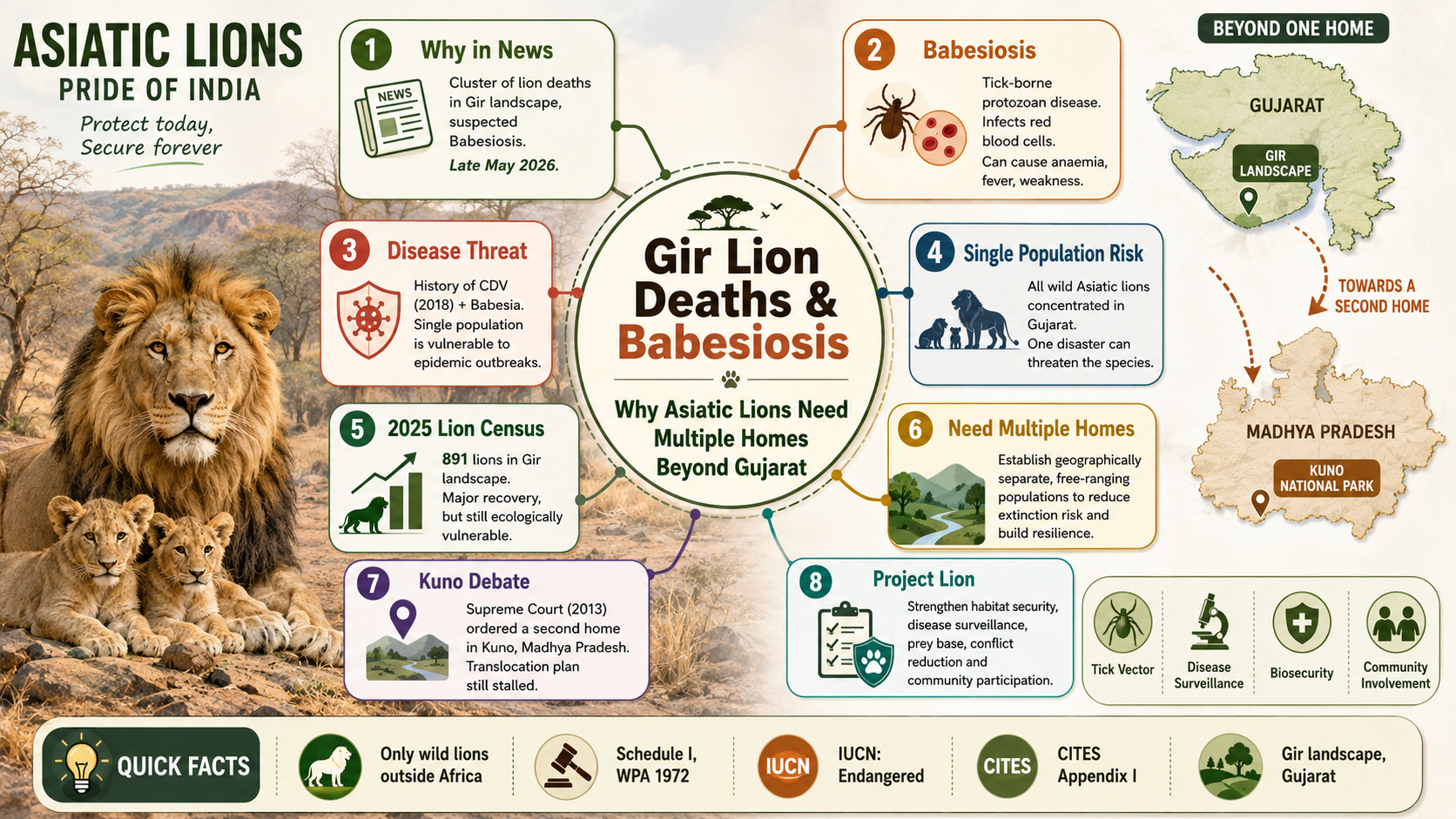
Gir Lion Deaths & Babesiosis Explained: Why Asiatic Lions Need Multiple Homes Beyond Gujarat
A cluster of Asiatic lion deaths in Gujarat's Gir landscape in late May 2026, linked to the suspected tick-borne disease Babesiosis, has revived the debate on whether India's only wild lion population is dangerously vulnerable. This article explains Babesiosis and Canine Distemper Virus, the single-population and genetic-bottleneck risk, the 2025 lion census, Project Lion, the stalled Kuno translocation, and the full conservation, legal and international framework for the Asiatic Lion.
• In late May 2026, the Gujarat Forest Department reported the death of a cluster of Asiatic lions, including several cubs, in the Gir Somnath and Amreli districts of the Saurashtra region.
• State Forest and Environment Minister Arjun Modhwadia stated that the deaths were linked to a suspected infection by the Babesia parasite (Babesiosis), a tick-borne protozoan disease.
+6 more points...
Who is the Asiatic Lion and why is it found only in one place in the world Identity and scientific classification: The Asiatic Lion is the only wild lion population surviving outsi...
"A single thriving population is not the same as a secure species." In the light of the recurring disease threats to the Asiatic Lion in Gir, critically examine the ecological rati...
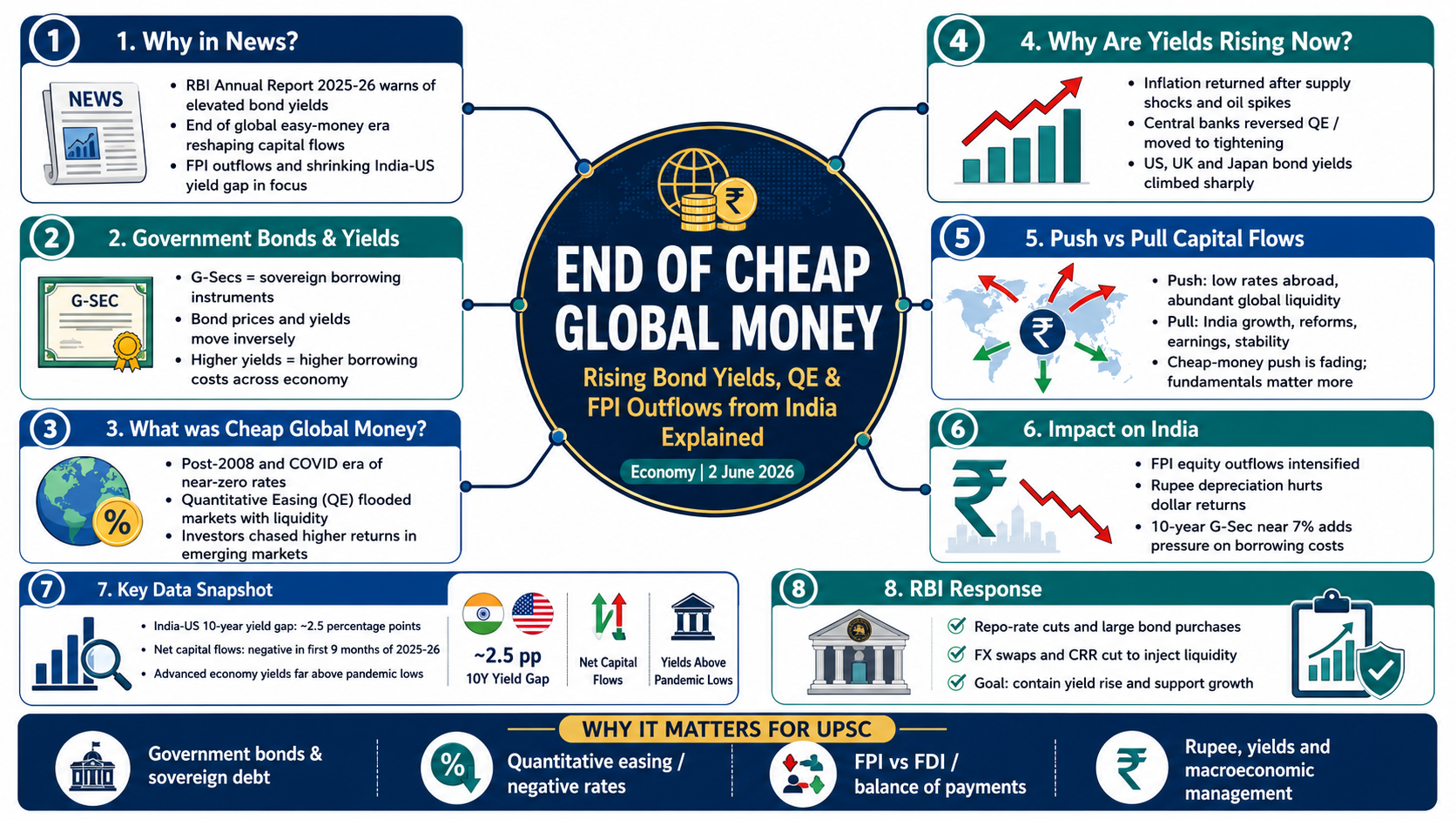
End of Cheap Global Money: Rising Bond Yields, Quantitative Easing & FPI Outflows from India Explained
The Reserve Bank of India's Annual Report for 2025-26 has flagged the risk of "elevated" sovereign bond yields and a possible reversal of the global monetary-easing cycle, while the Chief Economic Advisor has called the end of near-zero interest rates and quantitative easing the single most consequential shift in global capital markets. With foreign portfolio investors pulling out record sums and the India-US yield gap shrinking, this article explains government bonds, bond yields, quantitative easing, negative interest rates, push-versus-pull capital flows, and what the drying up of cheap global money means for India's markets, rupee and growth.
• The RBI's Annual Report for 2025-26 has warned that domestic bond yields could face upward pressure if the global monetary-easing cycle stalls or reverses amid persistent oil-price shocks and the fragile situation in West Asia.
• The report also cautioned that elevated sovereign yields can strain the investment portfolios of banks and financial institutions, while noting that the government's fiscal-consolidation commitment and the RBI's liquidity injections should help contain the rise.
+6 more points...
Q1. What are government bonds (G-Secs), and why are they treated as "risk-free" assets Meaning of a government bond: A government bond is a debt instrument through which a sovereig...
Q. "The end of the era of quantitative easing and near-zero interest rates marks a structural shift for capital flows into emerging economies." In light of this statement, examine ...
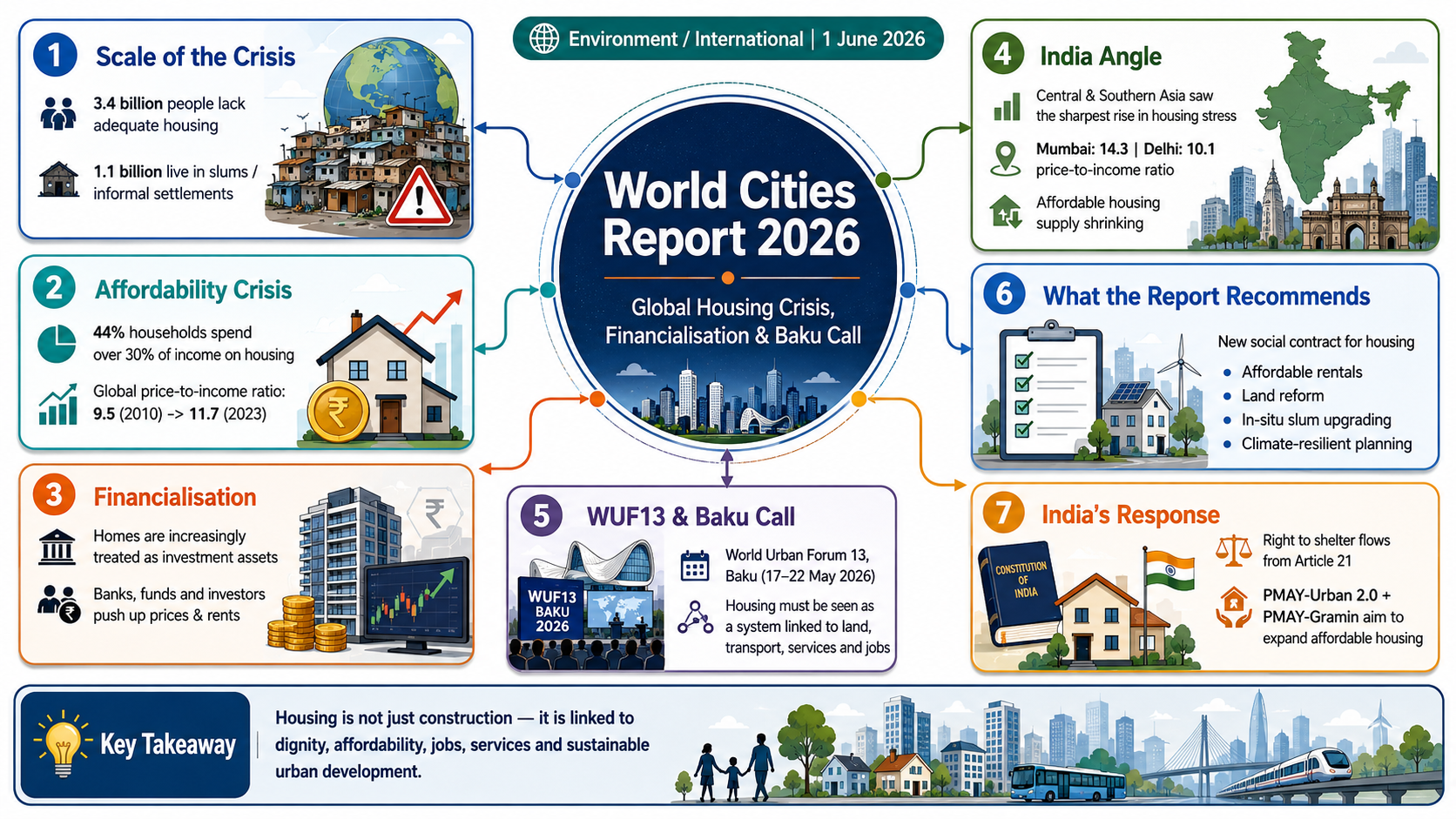
World Cities Report 2026: Global Housing Crisis, Financialisation & Baku Call Explained
UN-Habitat has released the World Cities Report 2026, "The Global Housing Crisis: Pathways to Action", at the 13th World Urban Forum (WUF13) in Baku, Azerbaijan, warning that 3.4 billion people now lack adequate housing and that financialisation is a key driver of unaffordability. This article explains the report's findings, the meaning and measurement of housing affordability, the concept of financialisation, India's specific data, the constitutional right to shelter, and schemes like PMAY.
• UN-Habitat (the United Nations Human Settlements Programme) released its flagship World Cities Report 2026, titled "The Global Housing Crisis: Pathways to Action", on 19 May 2026.
• The report was launched during the 13th session of the World Urban Forum (WUF13), held in Baku, Azerbaijan, from 17 to 22 May 2026, on the theme "Housing the World: Safe and Resilient Cities and Communities".
+10 more points...
Q1. What is the World Cities Report 2026, and in what context was it released The flagship publication: The World Cities Report is the flagship global assessment produced periodica...
"The financialisation of housing has transformed homes from places to live into assets to trade, deepening the affordability crisis in cities." In the light of the World Cities Rep...
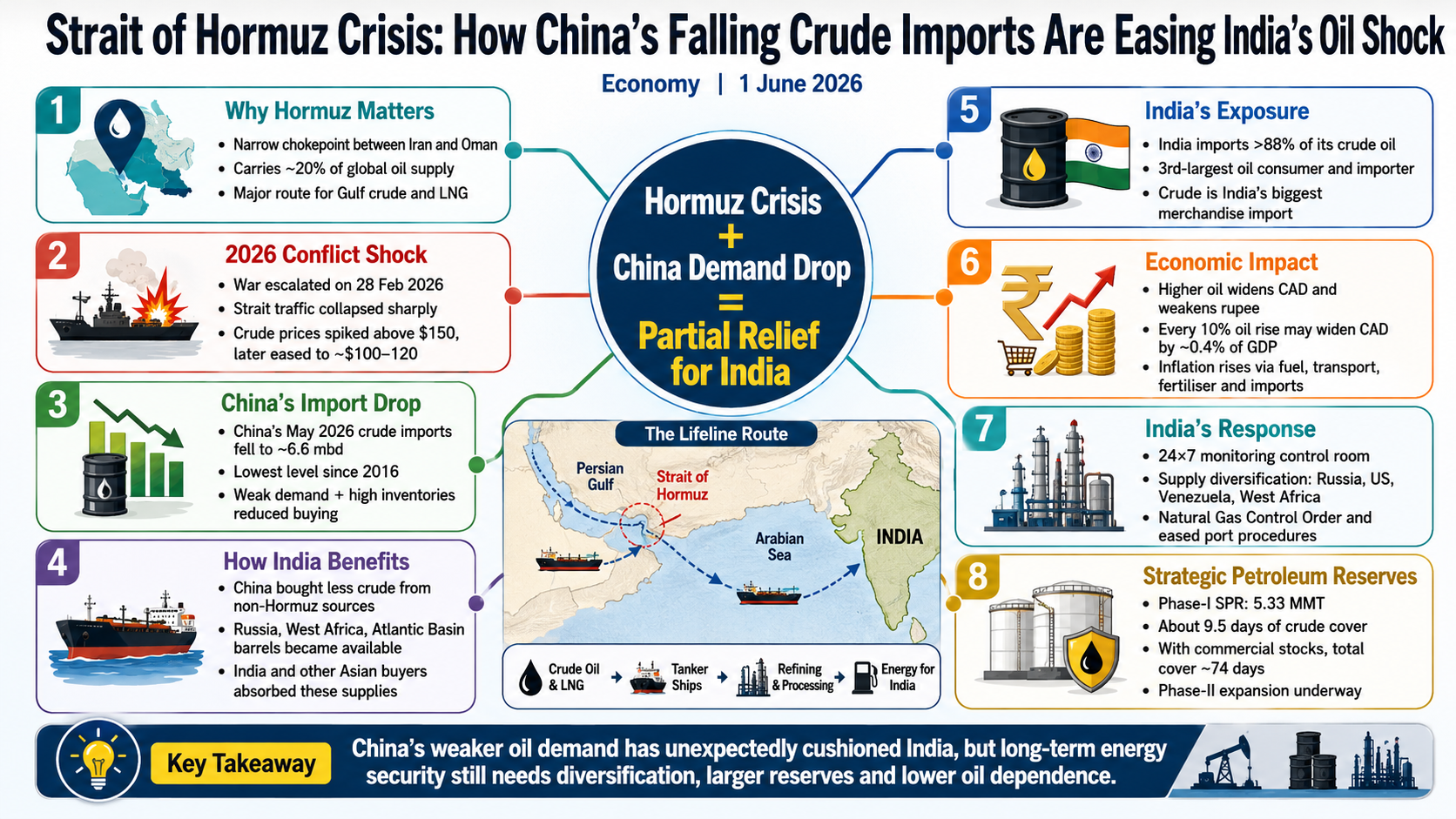
Strait of Hormuz Crisis: How China's Falling Crude Imports Are Easing India's Oil Shock
Amid the 2026 West Asia conflict and the disruption of the Strait of Hormuz, global crude prices have surged sharply. A steep fall in China's oil imports has unexpectedly freed up non-Hormuz supplies for India and other Asian buyers, cushioning the shock. This article explains the Strait of Hormuz chokepoint, India's oil import dependency, the impact of high oil prices on the current account deficit and inflation, India's Strategic Petroleum Reserves, and the government's energy security response — fully explained for UPSC Prelims and Mains.
• A military conflict in West Asia involving Iran on one side and the United States and Israel on the other broke out on 28 February 2026, leading to the effective closure of the Strait of Hormuz — the world's most critical oil chokepoint.
• The Strait normally carries roughly one-fifth of the world's seaborne crude oil and a large share of global Liquefied Natural Gas (LNG). Traffic through it collapsed from over 130 daily ship transits to fewer than 10 at the peak of the crisis.
+8 more points...
Q1. What is the Strait of Hormuz, and why is it called the world's most important oil chokepoint Location and geography: The Strait of Hormuz is a narrow sea passage that connects ...
"India's heavy dependence on imported crude oil and on a single maritime chokepoint exposes its economy to recurring external shocks." In the light of the 2026 Strait of Hormuz cri...

CBSE On-Screen Marking (OSM) Explained: Why Class 12 Digital Evaluation Faced Backlash
The Central Board of Secondary Education (CBSE) is facing nationwide criticism after rolling out On-Screen Marking (OSM) — a fully digital answer-sheet evaluation system — for Class 12 board exams for the first time in 2026, amid complaints of low marks, blurred scans, and a crashing re-evaluation portal. This article explains what OSM is, how digital evaluation works, why CBSE adopted it, what went wrong in the rollout, the constitutional and governance questions it raises, and the wider e-governance lessons for India's examination system.
• CBSE declared the Class 12 board results on 13 May 2026, evaluated for the first time entirely through On-Screen Marking (OSM) across all 116 subjects, with around 98 lakh answer scripts assessed digitally.
• Within days, students, parents, and teachers reported unexpectedly low marks (especially in Physics, Chemistry, and Mathematics), blurred or illegible scanned scripts, partially evaluated answers, and repeated crashing of the verification portal.
+8 more points...
Q1. What is On-Screen Marking (OSM), and how does the digital evaluation process actually work What OSM means: On-Screen Marking is a digital evaluation system in which examiners d...
The shift to On-Screen Marking by CBSE illustrates both the promise and the perils of technology-driven reform in India's public examination system. In light of this, critically ex...
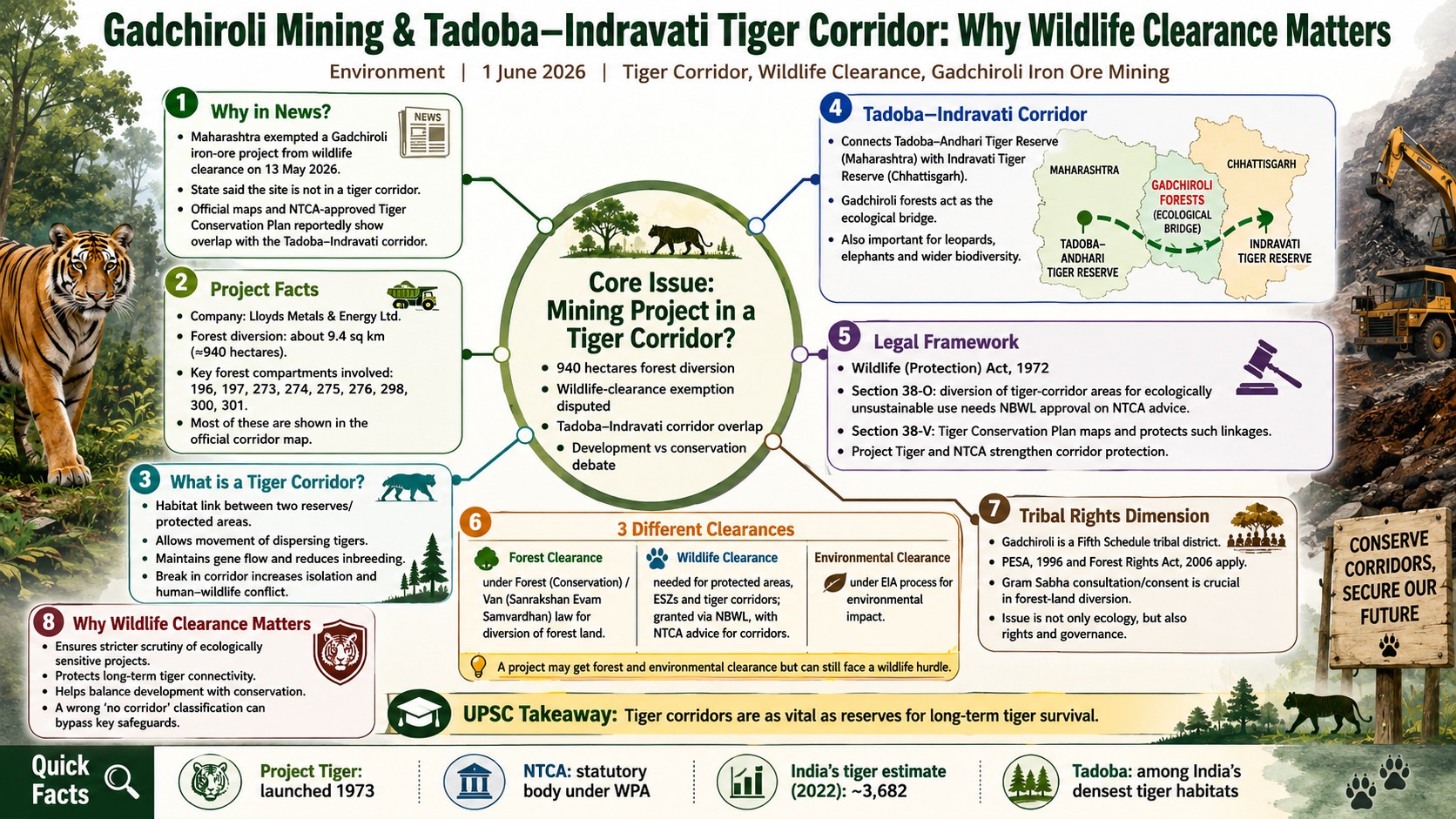
Gadchiroli Mining & Tadoba-Indravati Tiger Corridor: Why Wildlife Clearance Matters
The Maharashtra government has exempted a large iron-ore mining and processing project in Gadchiroli from wildlife clearance, stating the site does not fall in any tiger corridor — a claim that official maps and the NTCA-approved Tiger Conservation Plan appear to contradict. The project, involving diversion of 9.4 sq km of forest land by Lloyds Metals & Energy, overlaps the ecologically vital Tadoba–Indravati tiger corridor. This article explains what a tiger corridor is, the legal framework under the Wildlife (Protection) Act, 1972 (Section 38-O), Project Tiger, NTCA, the difference between forest, wildlife and environmental clearances, the role of the Forest Rights Act and PESA, and the development-versus-conservation debate this case raises.
• On 13 May 2026, the Maharashtra government exempted an iron-ore mining and processing project in Gadchiroli from wildlife clearance, stating in official communications that it was not located in any tiger corridor.
• Official documents reviewed by the press indicate that the site, in fact, overlaps the Tadoba–Indravati tiger corridor — contradicting the basis for the exemption.
+6 more points...
Q1. What exactly is the controversy over the Gadchiroli mining project The legal trigger: Under India's wildlife law, any project that diverts land lying within a notified tiger co...
"Tiger corridors are as critical to long-term tiger survival as the reserves themselves, yet they remain the weakest link in India's wildlife protection regime." In light of recent...
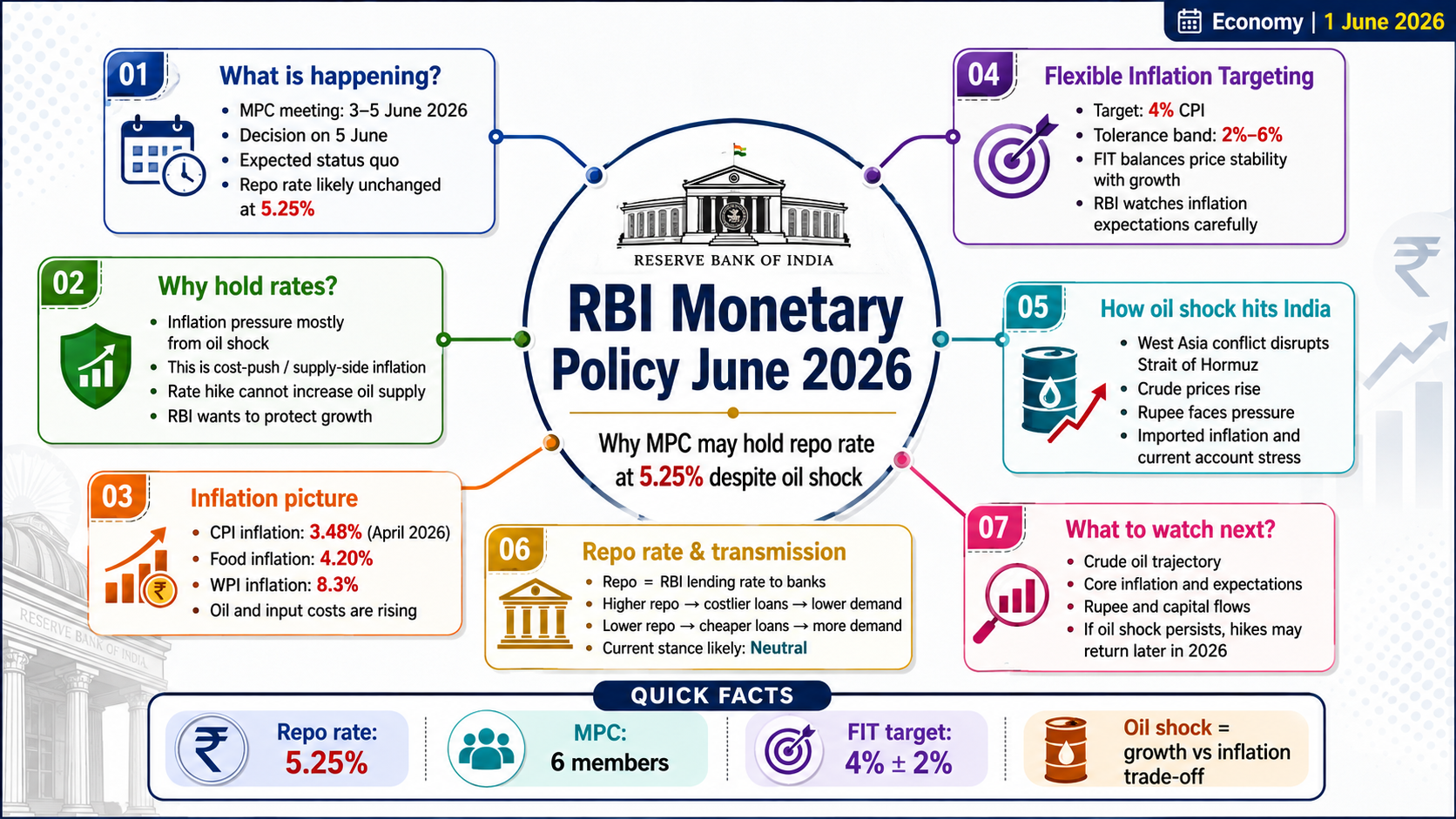
RBI Monetary Policy June 2026 Explained: Why the MPC May Hold the Repo Rate at 5.25% Despite the West Asia Oil Shock and Rising Inflation Risks
The Reserve Bank of India's Monetary Policy Committee (MPC) meets from 3 to 5 June 2026, with most economists expecting the repo rate to be held at 5.25% for a third straight time even as the West Asia conflict, rising crude oil prices, a weak rupee and foreign capital outflows push up inflation risks. This article explains the RBI's monetary policy framework, the repo rate, flexible inflation targeting, the MPC, the growth-versus-inflation trade-off, and how a global oil shock transmits to India's economy — everything an aspirant needs for Prelims and Mains.
• The six-member Monetary Policy Committee (MPC), chaired by RBI Governor Sanjay Malhotra, is scheduled to meet from 3 to 5 June 2026, with the decision to be announced on the morning of 5 June 2026.
• Market consensus expects a status quo: the benchmark repo rate is likely to be retained at 5.25% for the third consecutive meeting, with the policy stance kept "neutral."
+8 more points...
What exactly is the news event, and why does the June 2026 MPC meeting matter The decision in focus: The Reserve Bank of India's rate-setting body, the Monetary Policy Committee (M...
Q1. "Monetary policy is well-suited to managing demand-driven inflation but is largely ineffective against supply-side shocks." In light of the impact of the recent West Asia confl...
One Liner GK Today Facts
One-Liner GK Today Updates for SSC, Banking, Railway & Defence Exams
The Hindu Editorial Analysis
Daily The Hindu & The Indian Express Editorial Analysis & Summary for UPSC
PIB Summary & Analysis UPSC
Union Home Minister and Minister of Cooperation Shri Amit Shah Pays Tribute to Savitribai Phule on Her Birth Anniversary
Union Home Minister and Minister of Cooperation Shri Amit Shah paid tribute to Savitribai Phule on her birth anniversary, hailing her as a pioneer of women's education and social reforms who dedicated her life to empowering the marginalized and transforming society.
• Shri Amit Shah described Savitribai Phule as an inspiration for nation-building, emphasizing her relentless efforts in promoting women's education and eradicating social evils like caste discrimination.
• He noted that her visionary work continues to guide India's progress toward equality and empowerment.
+2 more points...
Who was Savitribai Phule Savitribai Phule (January 3, 1831 – March 10, 1897) was an Indian educator, social reformer, and poet, widely regarded as the first female teacher in moder...
Examine the contributions of Savitribai Phule to women's education and social reform in 19th-century India. How did her efforts challenge the prevailing socio-cultural norms and in...
President of India Presents National Energy Conservation Awards on National Energy Conservation Day
The President of India, Smt Droupadi Murmu, presented the National Energy Conservation Awards 2025 and prizes for the National Painting Competition on Energy Conservation during the celebrations of National Energy Conservation Day in New Delhi. This event underscores the government's focus on promoting energy efficiency, reducing carbon emissions, and aligning with sustainable development goals, which are crucial for India's environmental commitments under global frameworks like the Paris Agreement.
• The awards recognize industries, institutions, and establishments for outstanding efforts in energy efficiency, with categories covering power plants, hotels, and other sectors.
• President Murmu emphasized that energy conservation is the most reliable and eco-friendly energy source, urging wise and efficient usage to protect the environment and future generations.
+3 more points...
What is National Energy Conservation Day and its historical background National Energy Conservation Day is observed annually on December 14 in India, initiated in 1991 by the Burea...
Discuss the role of energy conservation in achieving India's sustainable development goals, with reference to key government initiatives and their impact on environmental and econo...
Magazine Summary & Analysis UPSC
Yojana, Kurukshetra and DownToEarth Magazine Summary & Analysis for UPSC
Study Category
Links heritage news to UPSC GS1 and SSC Culture.
Links security news to UPSC GS3 and SSC defence awareness.
Links economic news to UPSC GS3 and SSC Economic Scene.
Links environment news to UPSC GS3 and SSC General Awareness.
Links scheme updates to UPSC GS2 and SSC General Policy.
Links daily news to UPSC GS1 and SSC History.
Links world news to UPSC GS2 IR and SSC world awareness.
Links governance news to UPSC GS2 and SSC General Policy.
Links science news to UPSC GS3 and SSC Scientific Research.
Links sports news to SSC General Awareness and GK.

Daily Current Affairs MCQ Quiz Practice
Download Section
News Inbox
Stay updated with our Latest Analysis on Daily Current Affairs from The Hindu, The Indian Express along with our PIB and Editorial Analysis for UPSC and other Competitive Exams.